How it works
For: anyone deciding whether wow-stats is for them. At the end: you know what runs where, what leaves your computer, and which page to read next.
wow-stats never talks to the game. WoW Forever and a few well-known addons already write down what you do: levels, quests, loot, deaths, gear, auction prices. wow-stats reads those files after the game saves them, and turns them into pages you can act on.
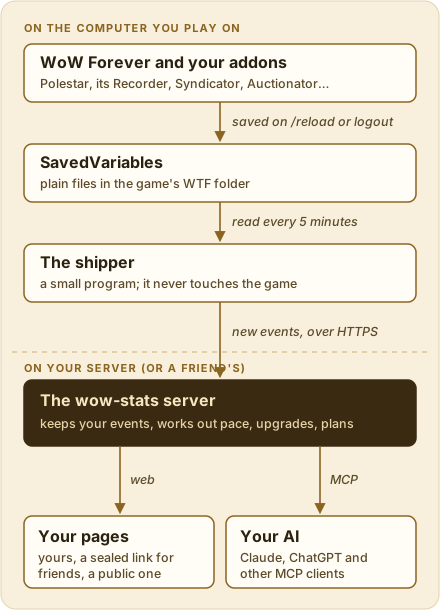
The four pieces
Section titled “The four pieces”The addons. Polestar and its Recorder do most of the work: route steps, levels, sessions, zones, deaths. Syndicator adds your bags, Auctionator your auction house scans, Questie or Altoholic the quests you did before. wow-stats ships no addon of its own. The full list: Addons it reads.
SavedVariables. That’s where addons keep their data: plain text files in the game’s WTF
folder. WoW writes them only when you /reload, log out or switch character. A crash or
Alt+F4 loses what happened since the last save, for every addon. So the one habit worth
having: /reload after a dungeon, an auction house scan, or before a break.
The shipper. A small program on the computer you play on. Every 5 minutes it reads what
changed in WTF (and the combat log, if you turned it on), turns it into events and sends them
to your server with your own upload password. It keeps a copy of everything it sent in a
WoWArchive folder in your home folder. It never reads your WoW or Battle.net password, and
nothing outside the WoW folder. What it sends.
The server. One docker compose up on a small box: 2 vCPU and 2 GiB of RAM run it for a
handful of players, and a year of one player’s events takes a few MiB. It keeps the events
and works out everything else from them, every time you open a page: pace, upgrades,
dungeons, plans. Someone you know can run it for you, and then you skip this part.
What you get out of it
Section titled “What you get out of it”Your page. Behind your login, with everything: your pace against Polestar’s route, the next upgrade per slot and where it drops, the dungeon worth running, your climb, one journal entry per play session. A tour: Your page at a glance.
Pages for others, if you want them. A sealed copy for the friends you pick (the key sits in the link, so the server can’t read it) and a public one cut down to an allow list. Neither ever shows other players, what killed you, or where your character is right now. What’s shared.
Your AI. The server speaks MCP, the protocol Claude, ChatGPT and a dozen other assistants use to call outside tools. Your assistant asks for your data and does the thinking in your own account: no model runs on the server, and wow-stats never sees the conversation. When the assistant quotes a number, the server re-runs the query behind it. Connect your AI.
Battle.net data, optional. With your own Battle.net API client, the server also fetches your character’s look (for the 3D view) and the WoW Token price; never the auction house, whose prices come from your own Auctionator scans. Blizzard’s terms cap that data at 30 days, so it lives in its own store with a 23-day retention. Battle.net data.
Where to go next
Section titled “Where to go next”- A friend sent you a link: Join a friend’s server.
- You want to see it first: the live demo, a made-up priest.
- You want to run it: Try it at home, 10 minutes with Docker.
- The parts in detail, for the curious: Architecture.